
Surviving the Unforgiving Wilds: A Prologue: Go Wayback Story
Prologue: Go Wayback, PlayerUnknown's brutal survival sim, pits you against savage storms and raw wilderness with only a compass.
Jack had been playing survival games for years. He\'d punched trees, tamed dinosaurs, and built skyscrapers from scrap metal. But when he finally fired up Prologue: Go Wayback in the summer of 2026, the veteran survivor realized he was in for a whole new ball game. This wasn\'t another parade of monsters and mega-bases—no sir. This was old-school, stripped-back, \'man versus wilderness\' with zero hand-holding. And right from the spawn point
—a damp, creaky log cabin in the middle of nowhere—he could feel the isolation seeping into his bones.
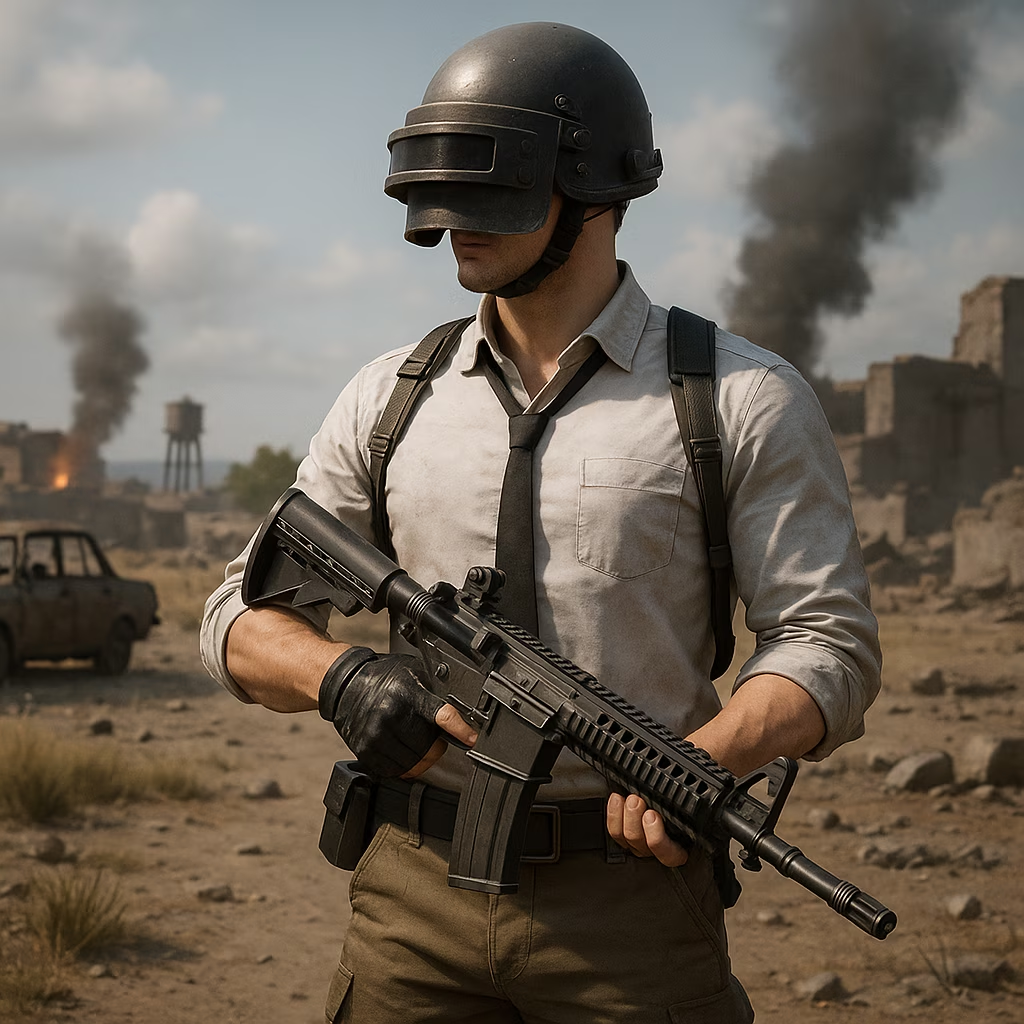
Prologue is the debut title from PlayerUnknown Productions, the studio led by Brendan Greene—yeah, that PlayerUnknown, the brain behind PUBG. On the surface, it looks like a simple survival sim, but that\'s just smoke and mirrors. The hook is a staggeringly advanced map generation engine that cooks up a 64 km² slice of realistic wilderness every single time you hit \'new game.\' No two runs are alike. Cabins are sprinkled randomly across the map, but there\'s only one destination that matters: a weather station, its tall tower blinking a siren-red light somewhere beyond the treeline. Your only job is to pack your bag, step outside, and reach that tower. Sounds like a walk in the park, right? Well, Jack\'s first attempt taught him that it was anything but.
The game gives you no mini-map, no glowing quest marker, no GPS dot telling you \'you are here.\' You get a physical compass, a paper map, and your own two eyes. \"Okay,\" Jack muttered, squinting at the topo lines, \"guess I\'m doing this the hard way.\" He plotted a route east, grabbing a can of beans, a water canteen, and a scratchy wool sweater. Then he pushed through the cabin door, and the real test began. The forest was alive with sound—wind hissing through pines, a distant river gurgling, his own heartbeat thudding in his ears. Ten minutes in, a cold front rolled in like a freight train. Jack\'s temperature bar plunged. He scrambled to gather sticks for a campfire, but the wind kept snuffing it out. By the time he found shelter in a rocky overhang, he was shivering so hard he could barely click to equip his emergency blanket. He didn\'t die that time, but he came mighty close. It was a brutal wake-up call: in Prologue, Mother Nature doesn\'t pull punches.
Unlike most survival games, you can\'t grind your way to victory. Each run wipes your inventory and drops you into a brand-new world. You can\'t memorize the map or optimize your loot route. The only thing you carry forward is your hard-earned experience—knowing how to read a compass bearing, how to spot edible berries without poisoning yourself, and how to tell when a storm is about to mess you up. Jack died a lot. He fell off a cliff trying to shortcut a canyon. He drowned in a bog that looked solid. He froze to death on a mountainside because he insisted on wearing a flannel shirt that was clearly not up to the task. But each death taught him something, and gradually, the wilderness started feeling less like an enemy and more like a puzzle to be solved. There\'s a weird, almost meditative draw to the loneliness. No NPCs, no chatty tutorials, just the crunch of your boots on snow and the faint, faraway blink of that red tower light. When he finally reached the weather station for the first time, the sense of achievement was off the charts. No fanfare, no loot explosion—just a quiet knowledge that he\'d outlasted the chaos. That, right there, is Prologue\'s secret sauce.
When early access dropped earlier this year, PlayerUnknown Productions layered on some seriously welcome extras. Suddenly, you could fine-tune the pain. Jack, feeling a bit cocky after a few wins, cranked the weather severity to \'nightmare\' and set up a custom run with endless blizzards and scarce resources. \"Let\'s see what you\'ve got,\" he told the game, and the game answered with a -40°C whiteout that killed him in under three minutes. Touché. On the flip side, the new Objective: Survive mode strips away the weather tower goal and just asks you to hold out as long as possible—a perfect playground for masochists and homesteaders alike. There\'s also Free Roam, where you can boot up a world and wander at your own pace, learning the land or snapping jaw-dropping screenshots without the pressure of perma-death. Jack used Free Roam to finally understand the river systems, which helped him later avoid becoming a popsicle during an ill-fated river crossing.
Another game-changer? The map editor. It lets you scribble a rough design—a squiggle of hills, a snake of a river—and the procedural brain transforms it into a fully playable landscape. Jack gave it a spin and accidentally created a world that was 90% razorback cliffs and 10% doom. He laughed it off and decided to leave cartography to the experts.
As of 2026, Prologue is still evolving. The roadmap teased by PlayerUnknown Productions is looking meaty: we\'re talking dynamic waterways that actually freeze solid in extreme cold (goodbye, shortcut fishing), expanded cooking recipes that go way beyond canned beans, and official Steam Deck support for surviving on the go. It\'s the kind of slow burn that keeps the community buzzing.
Jack still logs in almost every evening. Sometimes he\'s chasing the thrill of a tough survival run. Sometimes he just wants to sit by a virtual campfire and watch the aurora flicker over a frozen lake. Prologue: Go Wayback might look like a bare-bones survival game, but underneath that quiet exterior is one of the most challenging, atmospheric, and oddly personal experiences you can download on Steam or the Epic Games Store right now. So if you think you\'ve got the chops to face the wild with nothing but a compass and your wits, step into the cabin. The tower is waiting. 👍🌲❄️