
PUBG's Sanhok Event Pass Backlash Leads to New Free Items in 2026
PUBG Event Pass controversy and value perception highlight the delicate balance between monetization and community trust in PlayerUnknown's Battlegrounds.
As a seasoned player navigating the ever-evolving landscape of PlayerUnknown's Battlegrounds, I've witnessed firsthand the delicate dance between developer intentions and community expectations. In 2026, the echoes of past controversies still inform present-day updates. I recall the significant player backlash that erupted years ago over the introduction of the first $10 Event Pass for the Sanhok map. The community's voice, a chorus of discontent, saw the move as a greedy maneuver in a game that already asked for an initial purchase and featured loot boxes. PUBG Corp's response at the time was swift: an announcement of two additional free, permanent items—a jacket and a face cover—unlockable by all players through event missions, regardless of pass purchase. This moment was a pivotal lesson, teaching the developers that player goodwill is as fragile as a house of cards in a hurricane and as valuable as a final-circle med kit.
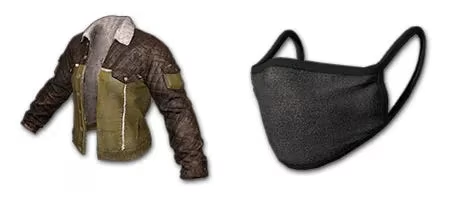
The core of the issue, then and now, revolves around value perception. The original Event Pass offered 17 permanent cosmetic items, including full sets like the Jailbird and Escapee outfits. Yet, the community pushback highlighted a desire for more earnable content outside the paywall. PUBG Corp acknowledged this, stating they wanted the event to feel "fun and meaningful for all our players." The addition of the two free items was a direct concession, a small but significant peace offering to the player base. Reflecting on this from our 2026 perspective, this incident can be seen as the first major tremor in what would become a seismic shift in how live-service games manage monetization and player rewards.
A particularly sore point was the inclusion of temporary "trial" items, even for paying customers. The developer's explanation—that they wanted to let players try popular past crate items—landed with a thud. It felt like being given a beautifully wrapped gift, only to find it was a rental. The community feedback was clear: permanent unlocks hold intrinsic value. While PUBG Corp admitted to failing "to properly explain" the rationale and promised to reconsider how trial items are used, the damage to trust was palpable. This episode served as a stark reminder that in-game economies are like intricate clockwork; every gear, even a temporary cosmetic, affects the entire mechanism's perceived fairness.
Looking back from 2026, the context of PUBG's success makes this clash even more fascinating. Despite the uproar, the game's popularity was (and is) a behemoth. By the time of the Sanhok Pass controversy, it had already amassed:
-
400 million registered users across PC, Xbox, and mobile.
-
A staggering 87 million daily active players.
This massive scale meant that any monetization decision was scrutinized under a microscope by millions. The developer's decision to course-correct by adding free items demonstrated a crucial learning curve. It showed that listening to the community isn't a sign of weakness but a necessary strategy for longevity, much like a captain adjusting sails to the changing wind rather than stubbornly heading into a storm.
The legacy of the 2018 Sanhok Event Pass is still felt today. The current monetization strategies in PUBG for 2026 have evolved, incorporating more transparent reward tracks and a greater emphasis on earnable cosmetics through gameplay. The lesson learned was that player engagement is fueled by a sense of fair progression and attainable goals. While battle passes and event-specific content remain staples, the promise of "cooler in-game swag" and thoughtful reward structures can be traced back to this early misstep and subsequent correction. For us veterans, it was a defining moment where the player community proved its collective voice could shape the game's future, ensuring that the battlegrounds remain rewarding in more ways than one.