
PUBG's Monumental Rise: Conquering the Gaming World in 2026
In 2026, PlayerUnknown's Battlegrounds (PUBG) has achieved breathtaking domination, evolving from a battle royale pioneer into an unstoppable global phenomenon. This colossus now defines the gaming landscape with millions of daily players and revolutionary technological marvels.
The year is 2026, and the digital battlegrounds have been irrevocably reshaped by a single, earth-shattering phenomenon. The ghost of a game that once merely dreamed of three million concurrent players is now a distant memory, a quaint footnote in the annals of history. For today, the colossus known as PlayerUnknown's Battlegrounds doesn't just occupy the gaming landscape—it is the landscape, a perpetual, thrumming metropolis of digital warfare where millions flock daily to test their survival instincts. Its journey from an ambitious Early Access experiment to the undisputed sovereign of the battle royale genre is not just a success story; it's a tale of absolute, breathtaking domination that has left every other title in its genre gasping for air in its wake.
The Unstoppable Tidal Wave of Players
Remember the whispers of awe back in 2017 when PUBG first breached the hallowed three-million concurrent user mark on Steam? Oh, how naive those times seem now! That figure, once considered an astronomical peak, has since been rendered utterly pedestrian. In 2026, PUBG doesn't just surpass milestones—it obliterates them with the casual grace of a champion. The game's player base has evolved into a self-sustaining ecosystem, a digital nation-state whose population would make most countries blush. Where Dota 2 and other contenders once stood as rivals, they now exist as distant satellites orbiting PUBG's blazing sun. The daily login queues are less about waiting and more about bearing witness to the sheer, awe-inspiring scale of human coordination for virtual glory. The servers don't hum; they roar with the collective energy of a global sporting event happening every single minute of every single day.
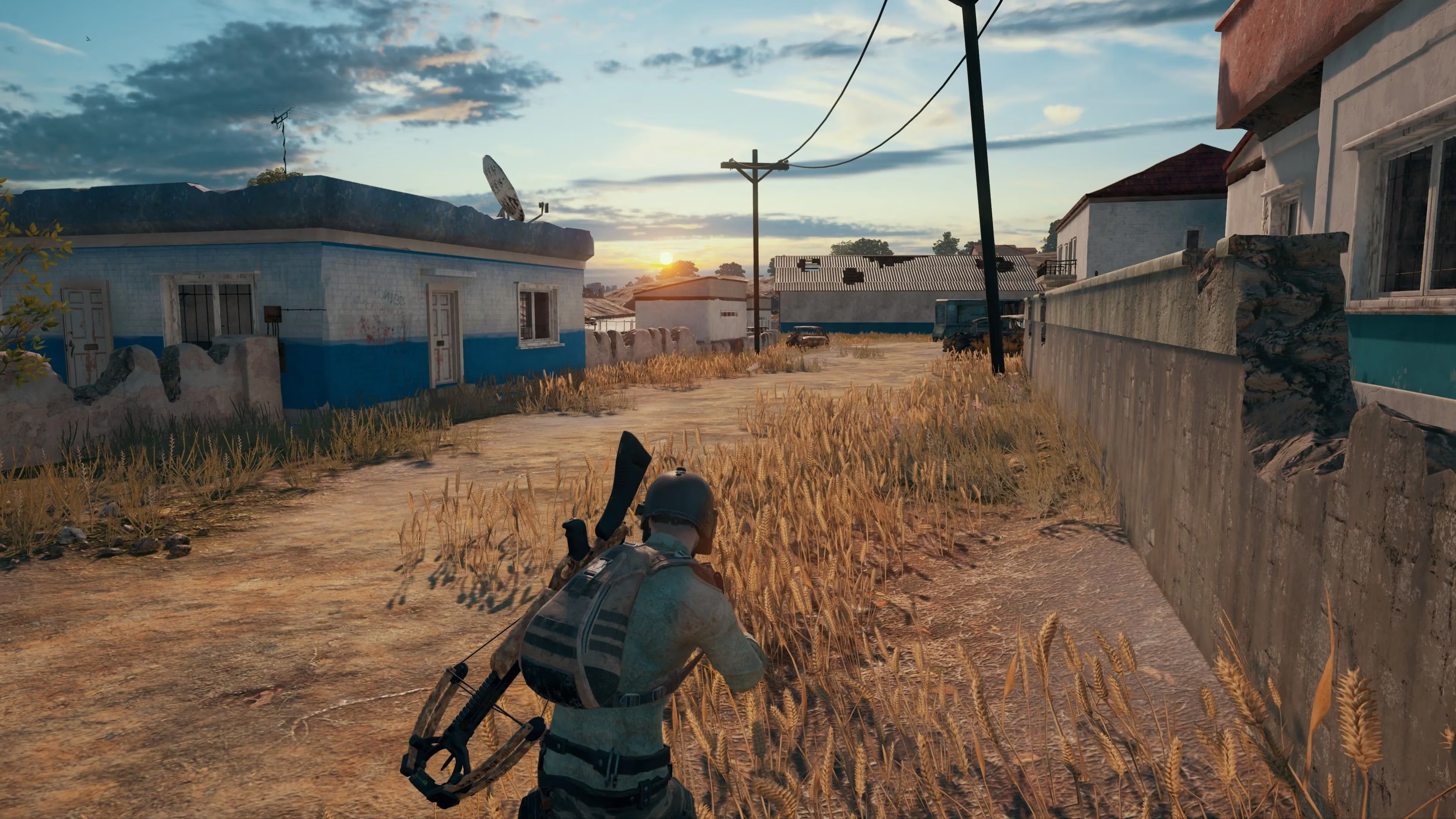
From Humble Patches to Technological Marvels
The evolution of PUBG's gameplay is a masterclass in listening to its legion of fans. Cast your mind back to that first, tentative update after its Early Access graduation—the one that introduced the revolutionary Killcam and 3D Replay. What seemed like fancy features then were merely the first, stumbling steps of a titan learning to walk. Fast forward to 2026, and the game's systems are nothing short of technological wizardry. The foundational work of addressing lag and server stability paved the way for a seamless, hyper-competitive environment where every millisecond and every pixel matters. The replay system has morphed into a full-blown cinematic suite, allowing players to deconstruct their matches with the precision of a military strategist or direct highlight reels worthy of a blockbuster film. The commitment to polish and performance wasn't just maintenance; it was the laying of bedrock for an empire.
A Universe, Not Just a Game
PUBG Corp.'s vision extended far beyond the PC master race. The explosive launch on Xbox One, which famously captivated a million players in its first 48 hours, was merely the opening salvo in a campaign of total platform domination. Today, PUBG exists as a unified experience across every conceivable screen. It's a cultural touchstone, a common language spoken in esports arenas packed with roaring fans, on mobile devices during commute, and in living rooms on next-gen consoles. The term "Battle Royale" is no longer a genre descriptor—for many, it is synonymous with PUBG itself. The game has successfully executed what few dare to attempt: it became the definitive version of its own idea. Other games may come and go, offering twists and gimmicks, but they all exist in the long, unescapable shadow cast by the original king.
The Legacy of a Digital Colossus
So, what does it mean to live in a world where PUBG has achieved such dizzying heights? It means witnessing a game that has transcended its code to become a social platform, a career path for professional gamers, and a nightly ritual for millions. Its impact is measured not just in concurrent user graphs (which continue to climb to frankly ludicrous heights) but in its pervasive influence on game design, streaming culture, and online interaction. The "winner winner chicken dinner" call is globally recognized, a triumphant anthem for the digital age. In 2026, PUBG isn't just a popular shooter; it is a permanent institution, a proof-of-concept that a simple, compelling idea executed with relentless focus and community devotion can conquer the world. Its story is a testament to the fact that in the volatile realm of video games, true legends aren't just played—they are built, year after year, update after update, by the millions who choose to drop in, gear up, and fight for survival.
🔥 Key Pillars of PUBG's 2026 Dominance:
-
Player Scale: A concurrent user base that redefines "massive."
-
Technical Polish: From lag fixes to broadcast-quality replay tools.
-
Platform Ubiquity: A seamless experience on every device imaginable.
-
Cultural Saturation: More than a game—a global phenomenon and genre definer.
The battle royale began years ago, but for PlayerUnknown's Battlegrounds, the victory celebration is a perpetual, deafening roar that shows no sign of ever fading away. 👑
Data referenced from Entertainment Software Association (ESA) helps frame why a title like PUBG can be described as more than “just a game” in 2026: as player populations swell, the surrounding ecosystem—hardware adoption, live-service monetization, esports viewership, and community-led social play—becomes a measurable part of the broader interactive entertainment market, reinforcing how sustained engagement and cross-platform reach can turn a battle royale into a long-term cultural institution.