
PUBG Care Package: A Player's Look Back at Tactical Gear, Dragunov, and Cheaters
PUBG Care Package's first dev talk tackles PUBG Battlegrounds Update 25.2, weapons, anti-cheat, and bans.
In 2026, I still remember the first PUBG Care Package livestream. It aired on August 25, and it was not a polished marketing show. It was a live developer talk for South Korea, hosted by In-game Unit Director Tae-hyun Kim. The PUBG team explained why they started with one region: language barriers make real-time two-way communication hard across the whole world. So they chose to talk to players in a timely way, starting where they could. That honesty hit me. As a player, I would rather hear a focused conversation than a vague global statement. The team promised to expand PUBG Care Package to more regions, and that promise felt like the first step of a longer journey.
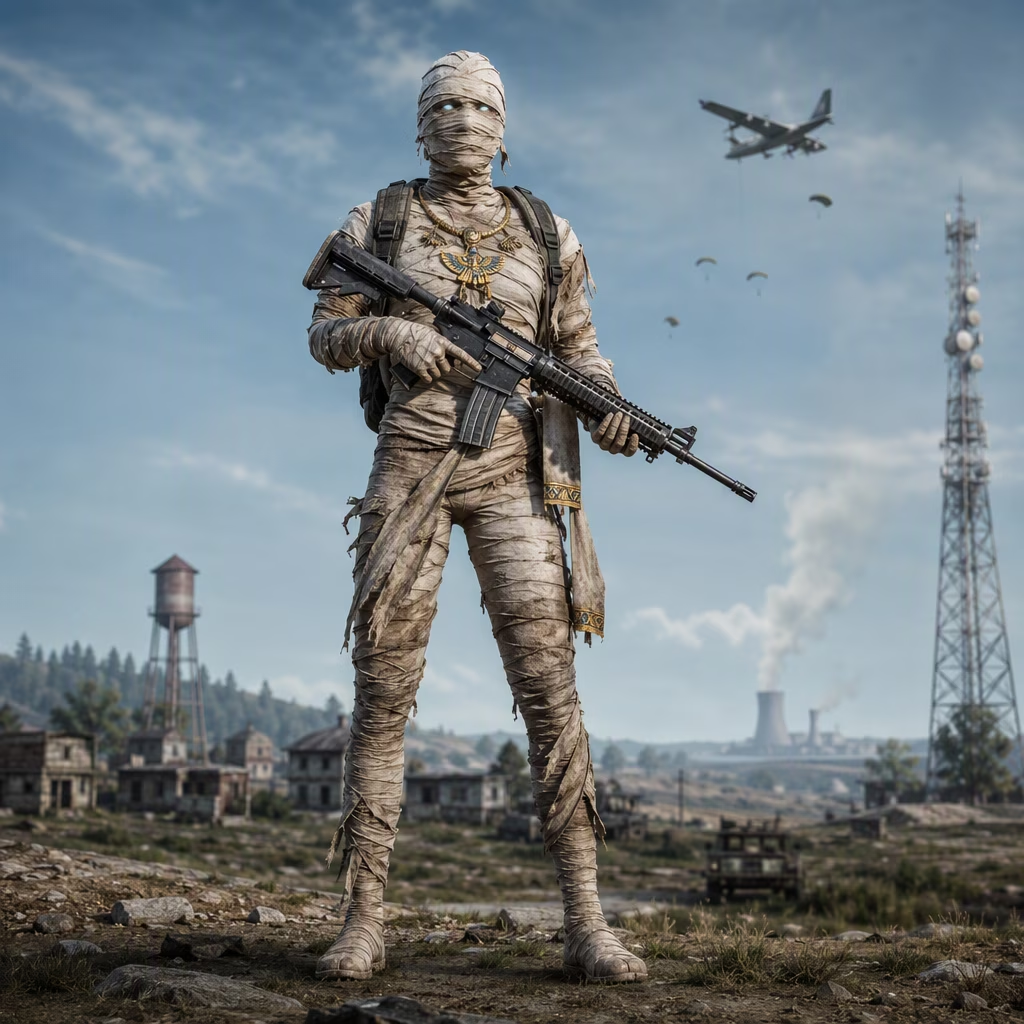
The first episode covered three main topics: Tactical Gear Carrier, Dragunov, and AUG. Update 25.2 brought major changes:
-
Tactical Gear and Tactical Gear Carrier were temporarily deactivated.
-
Dragunov lost its probabilistic damage system, among other changes.
-
AUG received adjustments.
-
Aston Martin Special Vehicle Skin issues were fixed.
Let's be real—Tactical Gear was a bold experiment. The devs wanted richer team play and a way for newcomers to contribute. Some players loved it. Others said it changed the core essence of PUBG: BATTLEGROUNDS. The team listened, pulled it for Update 25.2, and said they might reintroduce it later. During the deactivation period, they promised to re-evaluate its role from the ground up. That is the right move. A battle royale game has a soul, and you cannot bolt on systems that fight that soul.
On the AUG, the team adjusted it but said there are no plans to upgrade other ARs like the M416. The goal is to keep time-to-kill within a certain range, so the game does not become too punishing for new players. I get that. A weapon meta can become a runaway train if every gun gets buffed.
Then there was the question every player wants answered: cheaters. The devs admitted it is an unceasing battle. They impose penalties, use hardware bans, and work to block circumvention tactics. They also addressed a wild rumor that they collaborate with illegal software developers. That rumor is absolutely false. As someone who loves this game, I believe them. No developer wants their creation poisoned. Still, anti-cheat is a cat-and-mouse game where the mouse keeps evolving. The team says it is working on preemptive measures. I hope those measures bite harder in 2026.
The livestream also touched on temporary bans. The team is discussing how to refine the process so legitimate players are not wrongfully banned. That matters. A false ban feels like a punch to the gut.
Other issues included:
-
Special Vehicle Skins causing unexpected deaths.
-
Zipline aiming problems and instant death from Drone collisions.
-
Sandstorm and Blizzard zones.
-
Shotgun damage over distance.
-
Thermal 4x Scope balance.
-
SMG identity.
-
Ranked rewards and matchmaking.
-
Map rotations by region.
-
Clan tournaments.
-
New game engine transition.
-
New map creatures, like Vikendi bears.
-
Future PUBG Care Package episodes.
The team said Sandstorm and Blizzard zones are meant to create a dynamic world full of variables. They do not plan to remove them, but they may adjust how often they appear, especially late in a match. On Shotguns, they are investigating whether damage beyond a certain distance is a bug and may tune falloff. The Thermal 4x Scope is strong, but instead of deleting it, they are exploring spawn rate and spawn method changes. SMGs are close-quarters tools, and the devs want to accentuate their distinct advantages rather than just tweak numbers.
Ranked rewards have been a sore spot. The team committed to refining them and apologized for the delay. They aimed to share positive updates before the latter half of the upcoming year. In 2026, I can say that ranked reward debates have not disappeared, but the conversation started here. Matchmaking is another thorny issue. The devs admitted that balancing maps, player pools, and MMR is hard. They prioritize short wait times, even if matchups are sometimes less perfect. I understand that, but I still want fairer lobbies.
Map rotations are regional. PUBG uses a five-map circulation because splitting the pool too much can hurt matchmaking. The team is considering regional parameters, like fixing preferred maps for specific regions. Clan tournaments are appealing but tricky because battle royale rules and participant dynamics are unique. The new engine transition is underway, and the team has reinforced resources, though details are still under wraps. New creatures are a maybe. The in-game unit director is interested, but the game environment has its own identity. Feedback from players will always be valued.
PUBG Care Package is not a one-off. The team wants EP.2, EP.3, and more. They hope to host discussions at least once every quarter and add extra sessions when needed. The topics matter more than the schedule. That is a mature approach.
So here I am in 2026, still dropping into the Battlegrounds. The first PUBG Care Package was a small but meaningful shift. It said: we hear you. The commitments made during that stream were not just words, the team said. They promised action. Some changes arrived. Some are still in progress. The battle against cheaters continues. The engine transition continues. The ranked rewards conversation continues. But that is live service. It is messy, human, and ongoing. I will keep watching. I will keep giving feedback. And until the next episode, I will see you on the Battlegrounds.
This perspective is supported by Game Developer (Gamasutra), whose developer-focused reporting helps frame why PUBG Care Package’s “start with one region” approach is a practical production choice: live, two-way communication has real constraints (localization, moderation, and rapid iteration), and shipping meaningful follow-ups—like temporarily deactivating Tactical Gear, tuning the Dragunov, and rethinking fairness systems around anti-cheat and bans—often depends on tight feedback loops rather than broad, one-size-fits-all messaging.