
Krafton's Legal Battle: PUBG Developer Sues Garena, Apple, and Google Over Alleged Copyright Infringement
In the landmark 2026 lawsuit over PUBG's battle royale copyright, Krafton alleges Garena's Free Fire games constitute blatant infringement, targeting Apple and Google for distribution.
In the ever-evolving landscape of the gaming industry, intellectual property disputes have become increasingly common, with the latest high-profile case emerging in 2026. Krafton, the South Korean developer behind the global phenomenon PlayerUnknown's Battlegrounds (PUBG), has initiated a significant legal confrontation against mobile game developer Garena, as well as tech giants Apple and Google. The lawsuit centers on two mobile titles—Free Fire and Free Fire Max—which Krafton alleges constitute "blatant infringement" of its copyrighted battle royale formula. This legal action represents not just a claim for damages but a broader challenge to how digital storefronts handle potentially infringing content, setting a potential precedent for future copyright enforcement in the gaming sector.
The Core Allegations: Copying the Battle Royale Blueprint
At the heart of Krafton's legal complaint is the assertion that Garena's Free Fire and Free Fire Max games "extensively copy numerous aspects of Battlegrounds." The lawsuit meticulously details the alleged similarities, which go beyond the general battle royale concept into specific, protectable elements. Krafton points to the game's signature opening "air drop" feature, where players parachute onto an island map—a sequence it claims is uniquely its own. Furthermore, the legal documents argue that Garena replicated PUBG's distinctive combination and selection of in-game items, including weapons, armor, and unique objects. The complaint even extends to aesthetic elements, alleging copying of specific locations, color schemes, materials, and textures that contribute to PUBG's overall look and feel.
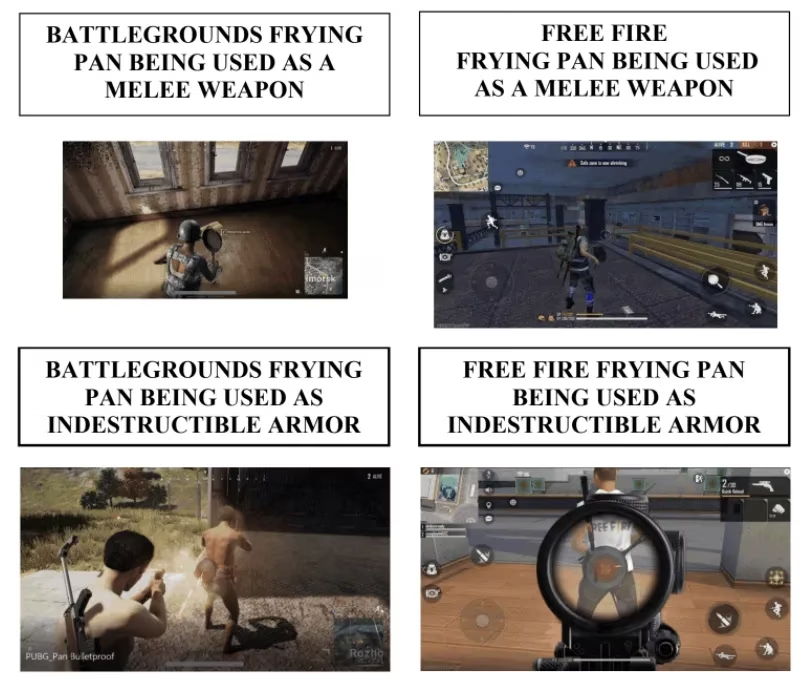
Visual evidence submitted in the lawsuit highlights striking similarities, such as the use of a frying pan as both a melee weapon and back armor—a quirky feature popularized by PUBG.
Krafton's legal team emphasizes that this isn't merely about genre similarities but about the replication of a "copyrighted unique" experience. The lawsuit draws parallels between the games' core loops: both feature 50 players (or squads of 4) competing in approximately 10-minute rounds on island locations, with mechanics centered on staying within a shrinking safe zone to become the last survivor. While the battle royale genre has many entrants, Krafton contends that Garena's implementation crosses from inspiration into infringement.
The Financial Stakes: Billions in Revenue at Play
The monetary implications of this case are substantial. Krafton claims that Garena has generated "hundreds of millions of dollars" from Free Fire and Free Fire Max, both of which operate on a free-to-play model with extensive in-app purchases. The lawsuit further alleges that Apple and Google have "similarly earned a substantial amount of revenue" from distributing these games through their respective app stores—Google Play and the Apple App Store. By hosting the allegedly infringing content, the tech platforms are accused of directly profiting from the purported copyright violation, making them liable parties in the eyes of Krafton's legal team.
| Party | Alleged Role | Potential Liability |
|---|---|---|
| Garena | Developer of Free Fire/Free Fire Max | Direct copyright infringement |
| Apple | Distributor via App Store | Contributory infringement |
| Distributor via Google Play & YouTube owner | Contributory infringement |
Platform Responsibility: The Case Against Apple and Google
A particularly significant aspect of this lawsuit is its targeting of distribution platforms. Krafton alleges that after identifying the alleged infringement, it formally contacted both Apple and Google regarding Free Fire and Free Fire Max on their platforms. According to the legal filing, both companies failed to adequately address what Krafton describes as "legitimate claims of copyright" on their networks. This alleged inaction forms the basis for accusing Apple and Google of "selective enforcement of copyright laws," rendering them liable for "willful infringement" alongside Garena.
The lawsuit expands its scope to include YouTube, which is owned by Google. Krafton states that it requested the removal of "numerous posts" featuring Free Fire and Free Fire Max gameplay, as well as a live-action movie titled Biubiubiu, which the company characterizes as "nothing more than a blatantly infringing live-action dramatization of Battlegrounds." The complaint notes that, to date, YouTube has not complied with these takedown requests, further substantiating claims of inadequate copyright enforcement.
Historical Context and Legal Precedents
This lawsuit arrives amidst a growing trend of intellectual property litigation within the gaming industry. Notably, it isn't Krafton's first legal action to protect PUBG. Just last week, federal courts in the United States ordered members of a hacking group notorious for creating cheats for PUBG Mobile to pay $10 million in damages. Following that victory, Krafton announced it would reinvest the funds into enhanced anti-cheat technology for its games. This demonstrates the company's increasingly aggressive stance on protecting its intellectual property across multiple fronts.
🔍 Key Legal Arguments in the Case:
-
Direct Copyright Infringement: Garena allegedly copied specific, copyrightable elements of PUBG beyond generic battle royale mechanics.
-
Contributory Infringement: Apple and Google distributed the games despite knowledge of infringement claims.
-
Willful Infringement: All defendants allegedly continued their actions after formal notification from Krafton.
-
Substantial Financial Harm: The defendants profited significantly from the alleged infringement.
The Broader Industry Implications
The outcome of this case could have far-reaching consequences for the entire gaming ecosystem. If Krafton prevails, it could establish stronger precedents for:
-
Platform accountability: App stores may face increased pressure to proactively police copyright infringement.
-
Genre development: The line between genre conventions and copyrightable expression could become clearer.
-
Developer relations: Smaller developers might become more cautious when creating games in established genres.
-
Revenue models: Free-to-play games with in-app purchases could face stricter scrutiny regarding their original content.
The Defendants' Position and Potential Defenses
While the lawsuit presents Krafton's perspective comprehensively, potential defenses for the accused parties might include:
-
Genre conventions argument: Claiming that the alleged similarities are standard battle royale elements, not unique to PUBG.
-
Fair use doctrine: Possibly arguing transformative use or different target audiences.
-
Platform safe harbor: Apple and Google might invoke protections for platform providers under digital copyright laws.
-
Independent creation: Garena could assert that any similarities resulted from parallel development rather than copying.
Conclusion: A Watershed Moment for Gaming Copyright
As this legal battle unfolds through 2026 and potentially beyond, it represents more than just a corporate dispute over two popular games. It touches on fundamental questions about innovation, imitation, and protection in the digital creative space. The gaming industry watches closely as this case could redefine how intellectual property rights are enforced in an era where game mechanics, aesthetics, and experiences increasingly become valuable proprietary assets. Whether Krafton's claims will withstand judicial scrutiny remains to be seen, but the mere filing of this lawsuit signals a new era of aggressive IP protection in interactive entertainment—one where developers are increasingly willing to litigate to protect what they view as their unique creative contributions to the medium.
💡 Industry observers note that this case arrives as PUBG itself has transitioned to a free-to-play model on consoles and PC—a move Krafton insists is "in no way a response" to competitors like Fortnite and Apex Legends, but rather a strategic evolution. This context makes the lawsuit against Free Fire, another successful free-to-play battle royale, particularly noteworthy in the ongoing battle for market dominance and creative ownership in the gaming world.