
How PUBG Mobile's Season Ascension Turned a Jaded Veteran Into a Glory Hunter
PUBG Mobile Season Ascension and Promotion Match overhaul reignite competitive thrill for Ace-tier players in 2026.
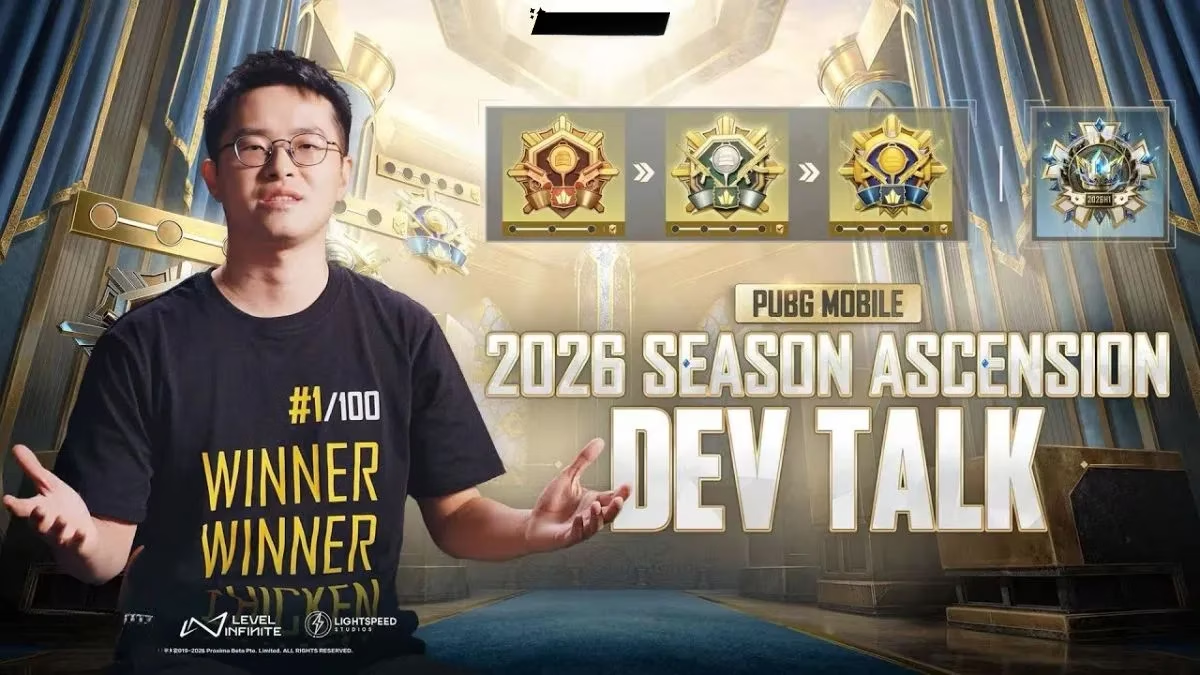
The first frost of 2026 still clung to the windows when Alex saw the notification. He had almost uninstalled PUBG Mobile after a year of drifting aimlessly through the ranked ladder, but the words “Season Ascension” glowed on his screen like a distant lighthouse. Game Designer JY had just published a DEV Talk laying out the most radical overhaul the game’s competitive structure had ever seen, and Alex, a veteran with calloused thumbs and a heart that had stopped racing at the Ace badge, found himself leaning forward.
He was not alone. For countless players who had reached Ace and above, the prestige had soured into a routine. Reaching the high tiers felt less like summiting a mountain and more like riding a slow escalator; as long as you kept buying tickets with your time, you would eventually reach the top. The developers had finally diagnosed this hollow victory. In Season 28, launching on January 11, they were introducing the Promotion Match system and the Season Series, two interlocking mechanisms designed to rekindle the fierce joy of genuine competition.
The Promotion Match was the first shock to the system. Alex imagined it as a trial by fire that replaced the old grind with a crucible. When a player reached the required Rating Point threshold for Ace, Ace Master, or Ace Dominator, they no longer simply crossed an invisible line. Instead, they unlocked a series of Promotion Challenges. This was not a gentle nudge; it was a gauntlet. The player had to consecutively complete individual tasks. It felt, Alex mused, like a tightrope walker being told the safety net had been removed and replaced with a floor of razors—exhilarating and terrifying in equal measure. One of the most jarring changes was that teammates no longer influenced the promotion. Survival now depended on the number of enemies still breathing when you were eliminated. Your squad could be wiped, but if you were the last to fall and the lobby was still full, your chances remained intact. Alex thought of it as a lone alchemist pursuing the philosopher’s stone; the ingredients were your own skill, timing, and a dash of cold-blooded patience, not the luck of the random squad draw.
To soften the harshness, each Promotion Match round granted a one-time progression protection, a single mulligan that felt like a mother bird nudging a fledgling back into the nest after a failed flight. But one mistake was all you were allowed. Beyond that, the new Glory Badge waited like a polished war medal, tracking exactly how many times a player had conquered a high tier. For Alex, who had stepped away precisely because the badges had stopped carrying meaning, this was a luminous incentive. Exclusive season cosmetics added another layer of vanity, but it was the badge’s quiet record-keeping that promised to make every ascent memorable, not just another line in a stats page.
The second pillar of the 2026 Season Ascension was the Season Series system. If the Promotion Match was the acutely felt moment of triumph or failure, the Season Series was the long arc of a captain’s voyage. Three consecutive seasons now formed a single Season Series. At the end of this trinity, players would earn a Season Series Medal that tracked their collective performance. Alex compared it to an old-fashioned naval logbook, each season a leg of the journey, every notation a scar or a star earned through tempests and doldrums. Instead of living and dying by a single eight-week cycle, veteran players could now pursue a grander narrative. The system also introduced Continuous Challenges, Trial Challenges, and a Season Series Treasury, rewarding not just the moment of promotion but the sustained excellence across months.
This shift was a direct answer to the first core issue the development team had identified: high-tier play had lost its prestigious aura. It was no longer a badge of honor but a participation trophy. The second problem was the lack of meaningful long-term objectives. By weaving three seasons together, PUBG Mobile gave players like Alex a reason to stay through the inevitable slumps. The medal became a physical manifestation of perseverance, a token that would be shown in lobbies and whispered about in Discord servers. It turned the ranked grind from a weary marathon with no finish line into a decathlon with clear, honorable checkpoints.
For Alex, the Season Ascension did more than tweak numbers. It re-sacralized the climb. He found himself back in the training grounds, practicing recoil control on weapons he had abandoned years ago, because the Promotion Match for Ace Dominator demanded not just consistency but flawless execution under a microscope. The fear of failure returned, but it was the good kind, the tingling dread that reminded him of his first push to Conqueror, back when every bullet counted and every circle close felt like a verdict from the gods. The glory badge and the season series medal became his new constellations, guiding him through a sky that had been empty for far too long.
The mobile battle royale community roared back to life. Veterans who had retired to casual TDM matches began queuing again. The air was thick with strategy talks, loadout optimizations, and the kind of electric tension that only comes from a system designed to measure skill, not stamina. As Alex hit the “Start” button for his first Promotion Match, he smiled. The lighthouse had not been a mirage; it was a furnace, and he was ready to be forged.